
Mosaic Book of the Term Prize Draw Summer 2026

Written by Rob Caudwell, Co-Founder of Penrose Education
23 June 2026
At Penrose Education we are on a mission to fill the (teacher development) world with thoughtfully designed and effective EdTech. But we also want to fill the (teacher development) world with books.
Each term we will be reviewing a book we have found helpful, interesting and/or thought-provoking in our attempts to develop our understanding of what exceptional teacher training, education and professional development looks like. Best of all – you could win a copy of one of these books in our Book of the Term Prize Draw!
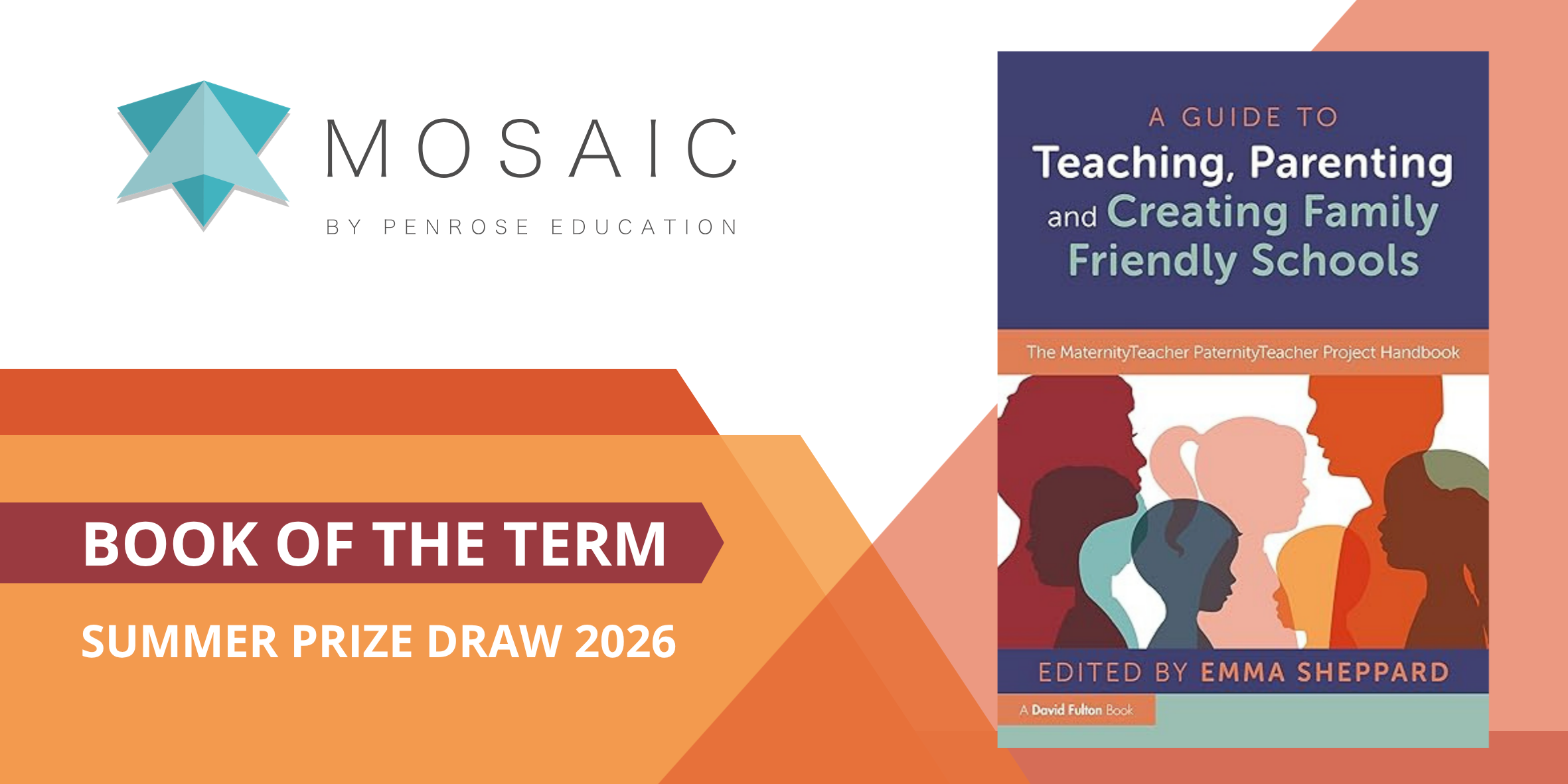
Our chosen book this term is: A Guide to Teaching, Parenting and Creating Family Friendly Schools edited by Emma Sheppard.
Why we chose this book?
This book, edited by Emma Sheppard, is billed as the “MaternityTeacher PaternityTeacher Handbook”, drawing guidance from a range of experts from across the MTPT Project network on how best individual teachers, and the schools they work in, can work together to make teaching a sustainable career for parents.
There are two reasons for choosing this book this term, an immediately obvious one and a slightly less obvious (but still hugely important) one.
First, the obvious one: every year, there are thousands of trainee/student teachers and early career teachers who are hoping to become parents, are expectant parents, or are already parents. All organisations (including ours!) that work with teachers in the early stages of their careers must spend time carefully thinking through how best to care for and support all teachers (of all parental statuses) into this wonderful profession of ours! This book has a number of sections explicitly addressing how to do this well.
Second, the less obvious reason: we should be preparing all trainee/student/early career teachers we work with, for the possibility of being a parent alongside teaching. This is not because all teachers will inevitably become a parent, but because every teacher should be able to become a parent alongside a successful career in teaching. We should be helping beginning teachers to understand and create healthy working patterns from the beginning of their careers that allow a successful working life to be compatible with a thriving personal life – one that may well include children! And, of course, we should be helping schools to offer beginning teachers (well, all teachers) the cultures and conditions that allow for this. The book explores how to navigate both the individual and organisational halves of these questions in depth.
If you don’t win, you can pick up a copy from Routledge here…
What we've taken from it
The book is structured around the different stages of becoming a parent, from planning for a baby and pregnancy, to maternity/paternity/shared parental leave, to returning to work and beyond. Each chapter, written by a member of the MTPT Project network, explores a particular stage. The contributors consider the practical, ethical and legal considerations, while sharing case studies of individuals and schools navigating these complexities, before summarising advice and recommendations for practice.
As a working parent, an employer and someone who deeply cares about the teaching profession, there were many things I was inspired by and learnt from this book. They largely fell into three categories.
"For school leaders, creating family friendly environments for staff is both a moral and strategic imperative. Schools where colleagues feel able to bring their whole fulfilled selves to work, with the autonomy to set boundaries over their personal and professional lives, are less likely to leave both their current setting, and the teaching profession. Low staff turnover enables schools to look to the long-term and create happier and more purposeful environments for their students."
- p196, Emma Sheppard
"Parent-teachers: you are an asset. You are valuable. Your insight will impact the progress of the students in your care. Your voice will help shape the future culture of our schools."
- p188, Flo Keith
"Far from believing that parent-teachers are a weak link in the chain, leaders should cotton on to the rich seam of experience, expertise and commitment stored in our parent-teacher community. By asking what these colleagues need to flourish, school leaders will find themselves with a wealth of strategies to implement - some simple. some ambitious - that will improve school culture for everyone."
- p223, Emma Sheppard
The first thing I appreciated about this book, is how highly it values parent teachers. Some of the contributors warn against the tendency of some parent teachers to see their parental status as a problem or a hindrance or something that prevents them from doing their job as well as they should. This book makes it very clear that parenthood is always something to be celebrated. Parenthood can bring joy, meaning, perspective and growth to people’s lives.
The contributors are not naïve, they appreciate that parenthood can be hard, that being a working parent can be hard and that specifically being a teaching parent can be hard. Sections of the book outline why teaching – a seemingly family friendly profession – can often pose real challenges to those with families. The book also explains very clearly (supported by a wide range of research, including the MTPT Project’s own research) that in the modern world, the costs of parenthood still often fall much more heavily on mothers than fathers.
But the authors are very careful not to position motherhood, fatherhood or parenthood as simply problems to be mitigated against. Parent teachers have so much to offer the education sector, and schools have so much to gain, if they can be given working conditions that allow them to flourish.
"Parental guilt, juggling, and being torn between two identities are often talked about when discussing returning to work but let's flip the narrative: being a professional working parent provides a great role model for our children, enables us to provide for them not only what they need but the luxuries of life too, and enables parents to live richly fulfilled lives - which in turn makes us better parents to our children. We can't do both things at once but we can do things in harmony."
- p153-4, Charlotte Woolley [original emphasis]
Second, I really appreciated just how inclusive the book is. The book has very carefully been written to consider the perspectives, needs and preferences of all parent teachers and potential parent teachers. There is plenty of guidance for mothers, fathers, trans and non-binary parents and non-birthing parents. Careful consideration has been given to the various ways a teacher might become a parent including adoption, fertility treatment and surrogacy. Wrapped around all of this is carefully researched guidance on the nuanced legalities surrounding the different journeys to parenthood.
Beyond this, however, the contributors are also really careful to be inclusive of the different opinions about, approaches to and values around being a working parent. The authors are really careful to never suggest what a parent teacher should be doing or feeling or aspiring to at any particular stage. They regularly remind us that “wellbeing”, “work-life-balance”, “family” mean different things to all of us. What one parent teacher might want, might not be what the next parent teacher wants. We need to understand and accept this form of diversity too.
The book concedes that this approach to inclusion has implications for employers. Schools who want to support their staff, have to be prepared for different teachers to want different things as they become parents. This doesn’t mean every school can always offer every possible option, but the more flexibility (and clarity around what options exist) that schools can offer their staff, the more likely schools are to meet the different needs and preferences of their staff.
"On a number of occasions, we have seen that compassionate leadership needs to go beyond the law and offer enhanced provision to colleagues so that they can enjoy the time that they have with their new babies, children and growing families. Change on a national level is likely to be slow when it comes to provision such as neo-natal leave, enhanced miscarriage leave or even equal leave for fathers and non-birthing parents. Where schools can take a stand and treat new parents with greater dignity and equality, we strongly encourage them to do so to create happy workplaces."
- p98, Charlotte Bell
"Family friendly schools that promote teachers interviewing at eight months pregnant, or create new working practices to accommodate their school's first adoptive father, exist. In many cases, they exist with a warm nonchalance that expresses a common-sense attitude: their staff are their greatest asset, and their staff are human beings. Why would their leadership teams and colleagues do anything other than empower these jewels to live purposeful and fulfilled lives both at home and within their professional spheres? After all, happy and effective teachers deliver. high quality lessons, and high quality lessons result in positive student outcomes - our bread and butter as educators."
- p4, Emma Sheppard
My final takeaway, is a simple one, that family friendly schools are absolutely possible! The book is full of case studies and examples of individual teachers and schools that have made teaching completely compatible with family life. Often this has required bold individuals willing to blaze a new trail and ask for conditions previously untried, or leaders who are willing to go beyond what is legally required to offer conditions that are ethical, fair and thoughtful. But when and where this happens, we see schools that are making teaching and parenting more harmonious. And we also see the rich wider benefits that this entails both to the individual teachers themselves and to the schools they work in.
The book reminds us just how many parent teachers there are, and in particular just how many mother teachers there are. It also highlights the sobering statistics around how many teachers leave the profession each year, and the emerging evidence that links this attrition to parenthood generally and motherhood specifically. This book contains clear, sober reminders of the seriousness of the challenges that sector faces, but it also contains a huge amount of hope that when done well, family friendly schools are possible, and that these schools are retaining, supporting, promoting, and ultimately valuing teachers who otherwise might have left the profession.
"where teachers perceive they are being asked to choose between their families or their work, they choose their children. This choice - by any parent, regardless of gender - should be respected and valued, whether this is by retaining teachers through flexible working practices, understanding more about what job satisfaction means to them, or ensuring that roles are accessible to returners, who are supported once they step back into the classroom."
- p252, Sherish Osman
How can I win a copy?
We are giving away three copies of this book to anyone working in positions related to teacher education, training and development.
Click the button below to be in with a chance to win.
Entries extended to close 11:59pm on Sunday 13th September 2026. We will randomly select the lucky winners on Monday 14th September 2026.
Upcoming MTPT Events: Supporting Student Teachers Who Are Parents
The MTPT Project are running a series of online workshops designed to support trainee teachers who are parents, alongside the mentors and teacher educators who work with them.
The programme explores how parent-trainees can navigate the transition into teaching, while also providing practical guidance for mentors and programme teams supporting them throughout the training year.
PAST EVENT: Supporting Trainees who are Parents
8 July | Online | For mentors, ITTE leads, PCMs and TSH colleagues
PAST EVENT: Teaching and Parenting: Realistic Expectations
9 July | Online | For those preparing to balance teacher training with their parenting roles
PAST EVENT: Teaching and Parenting: Managing Change
21 July | Online | For trainee teachers who are parents
PAST EVENT: Supporting Trainees who are Parents
10 September | Online | For in-school mentors supporting trainee teachers who are parents
BOOK YOUR PLACE
See last term's Book of the Term below:
Mosaic Book of the Term Prize Draw – Spring 2026
Win a copy of “Teacher Recruitment, Retention and Career Progression: A Guide for School Leaders” edited by the Chartered College of Teaching AND “Cultivating Belonging in Schools” by Hannah Wilson in Mosaic’s special DOUBLE Spring Book of the Term Prize Draw!